
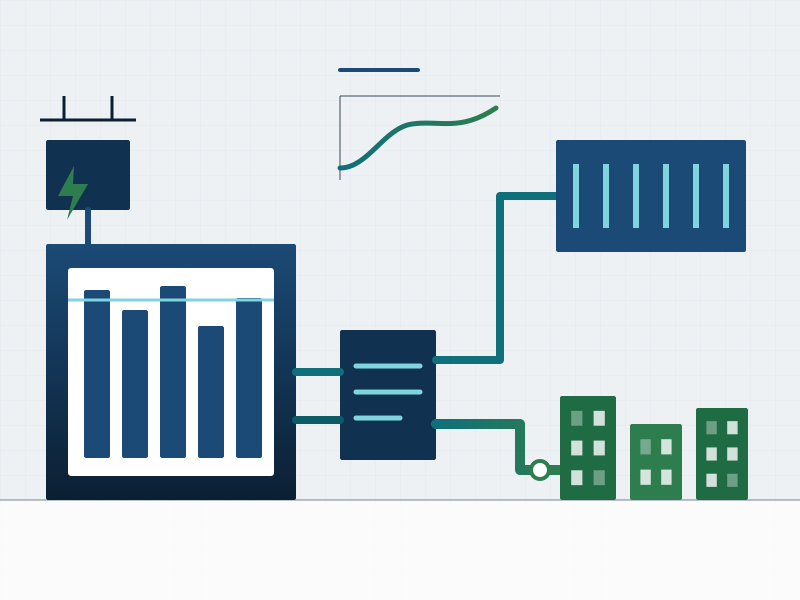
A new data centre is decided by two things that used to be secondary: whether power can be connected within the programme, and where the heat goes. Rack densities have moved faster than the thermal designs built around them, and heat that used to be rejected to the sky is becoming an asset with a counterparty attached. Both are design-stage decisions, and neither is recoverable cheaply once the building is standing.
What this changes about the work
- Thermal architecture is chosen before the building is fixed, not fitted around it afterwards. A hall carrying high-density racks is a liquid-cooled hall with several linked loops to design — cold plate, technology cooling system, facility water and heat rejection — and plant space, riser routes and structural loads all follow from that choice.
- Temperature decides almost everything downstream. The supply and return temperatures chosen for the facility water loop set the free-cooling hours, the plant efficiency, and whether the rejected heat is worth anything to anyone else. It is the cheapest decision to get right and among the most expensive to revisit.
- Heat offtake is a feasibility question with a counterparty, not an efficiency measure. It depends on a network that may not exist yet, and on an offtaker who has to want the heat at the temperature and the times it is actually available.
- Grid connection is a programme question, not a procurement one. Connection and substation works can decide a project even where regional capacity exists, so the connection strategy belongs in the siting decision rather than after it.
- Water is a siting and community constraint as much as an engineering one. Evaporative cooling buys efficiency at a water cost that is contested in exactly the places where water is scarcest, and the trade-off against power and capital should be made explicitly and written down.
- Design for the next step in density, not only the first. The thermal infrastructure outlives the hardware it was specified for.
The UK position
Heat network zoning under the Energy Act 2023 changes the question a UK scheme has to answer. Within a designated zone, certain buildings can be required to connect to the network, and large sources of low-carbon or recoverable heat can be required to supply it. Whether a site sits inside, beside, or well away from a zone is therefore a siting-stage input to the thermal design, not a matter to be picked up at commissioning.
Connection is the other half. Reform of the connections queue has replaced first come, first served with a gated process that favours projects able to demonstrate they are deliverable, and data centres are now treated as critical national infrastructure with dedicated routes for capacity in designated growth areas. A scheme that cannot evidence its readiness waits behind ones that can.
Both point the same way: the decisions that determine whether a UK scheme is consentable, connectable and able to place its heat are taken at concept stage, when coolant temperatures, heat rejection route and plant location are still open.
What we look for
- A thermal design fixed to the rack density of the day, with no stated path to the next step, so the first hardware refresh strands the plant
- Heat rejected at a temperature too low to be worth anything to any offtaker, where a modest design change would have made it useful
- Free-cooling hours left on the table because the loop temperatures were set conservatively and never revisited
- Redundancy specified by convention rather than derived from the availability the workload actually requires, then sized and paid for accordingly
- A connection and substation programme assumed rather than tested, with the whole schedule resting on it
- Water and power traded against each other implicitly, in a decision nobody recorded
Our core activities here
- Thermal systems assessment — establishing what the cooling system actually does across its whole operating range rather than at the design point: loop temperatures and approach, part-load behaviour, where capacity is genuinely constrained, and how the measured position differs from the design intent.
- Optimisation studies — coolant supply and return temperatures, plant sequencing and staging, free-cooling hours, containment and airflow where air remains, and control strategy. Raising loop temperature is usually the highest-leverage single change available, and we work through what it does to capacity, resilience and the IT estate before recommending it.
- Heat recovery and recycling — how much heat is available, at what temperature, and how continuously; what on-site reuse is possible before export is considered; whether a heat pump uplift is needed to meet an offtaker’s flow temperature, and what that costs in electrical input and plant space against the revenue or obligation it satisfies.
- Feasibility and concept design — options developed far enough to be costed and decided: heat rejection strategy, plant and riser allocation, offtake route and counterparty, connection strategy, and the water and power trade-off, with the evidence, assumptions and data gaps written down alongside the recommendation.
How our services apply here
- Energy Opportunity Sprint — early screening of a site or a proposed scheme, with the data gaps named rather than assumed away
- Project Feasibility Pack — a costed, evidenced case for a specific thermal option or a heat offtake scheme, including the counterparty question
- Decarbonisation Roadmap — a staged path for an operating estate, including the heat recovery trajectory
- Annual Energy Portfolio Office — standing governance where an operator holds several sites
Review requirements
Work affecting electrical capacity, protection or grid connection carries the relevant electrical studies as part of the scope. Where a recommendation depends on a heat offtake arrangement, the counterparty position is established and stated with it, because a thermal design justified by an offtake that never materialises is worse than one that never assumed it.